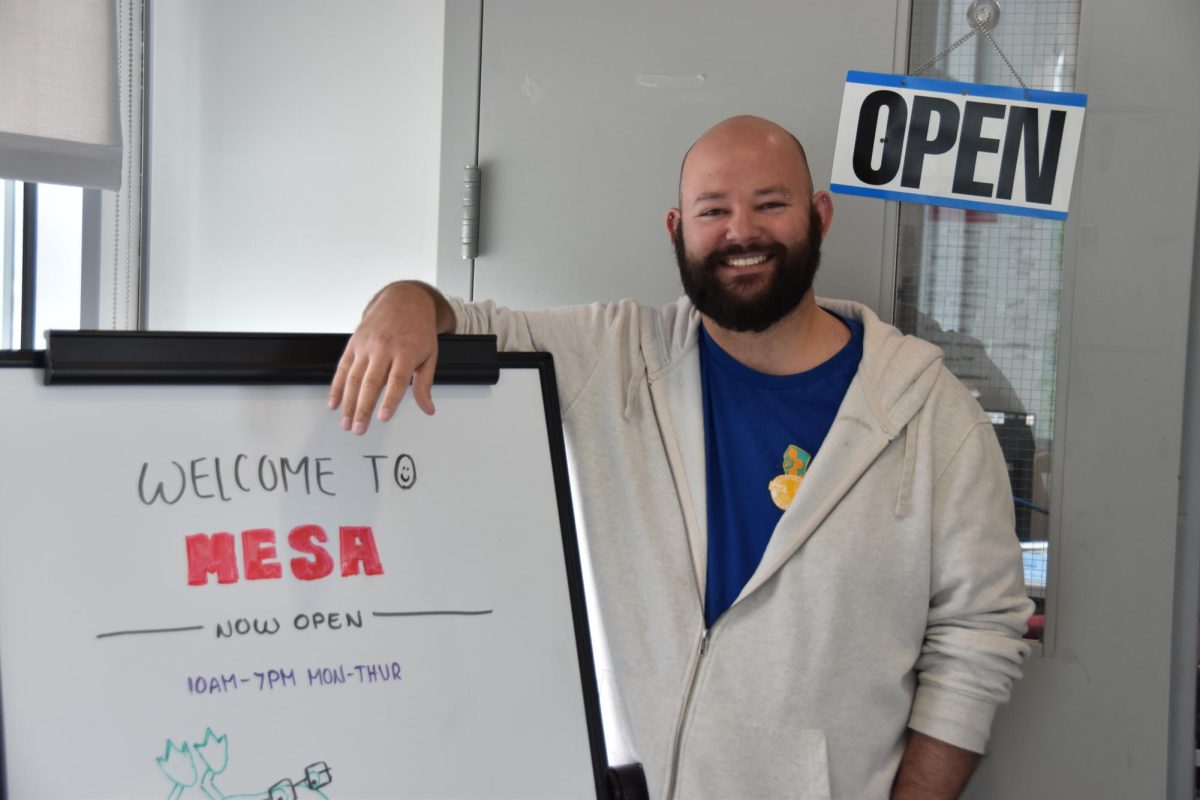
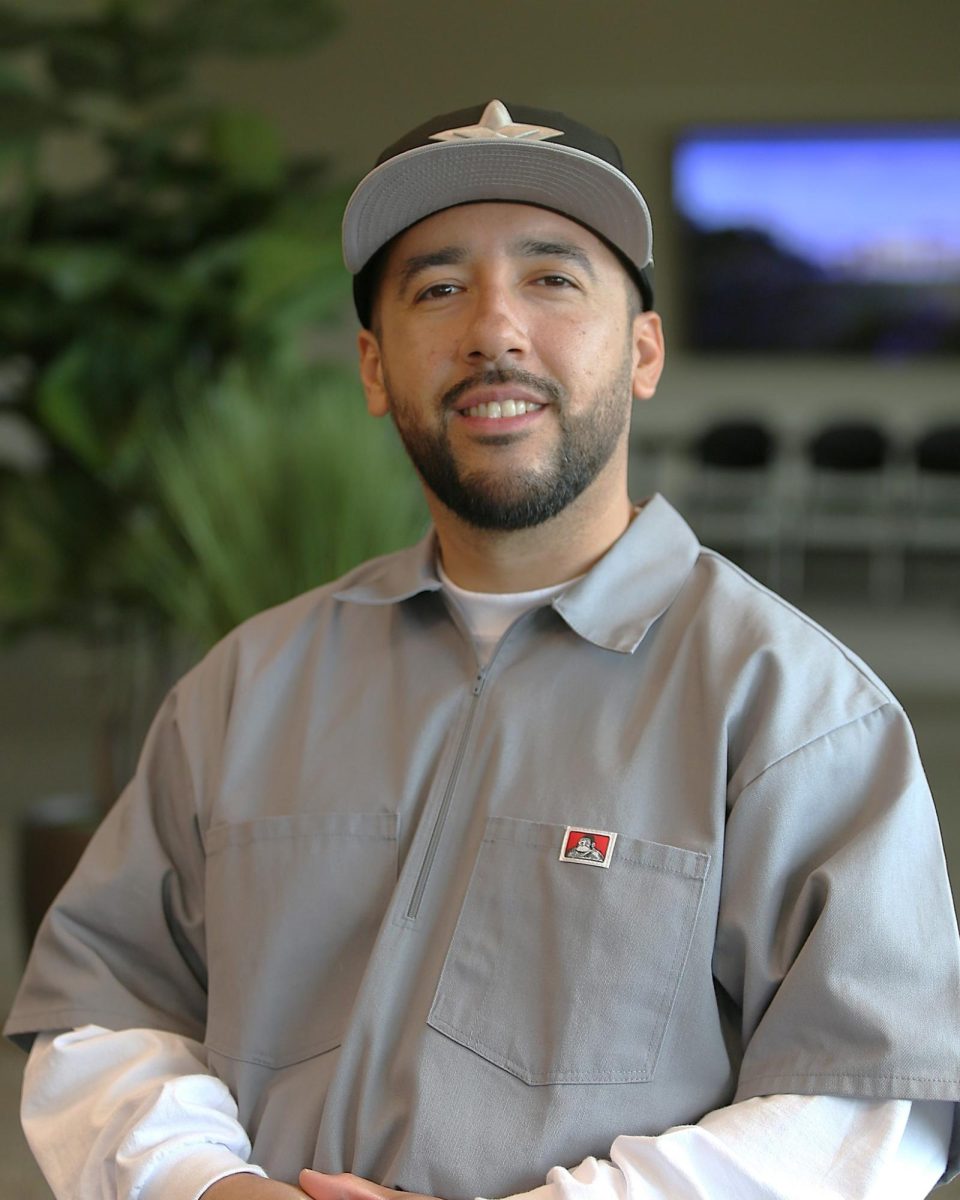
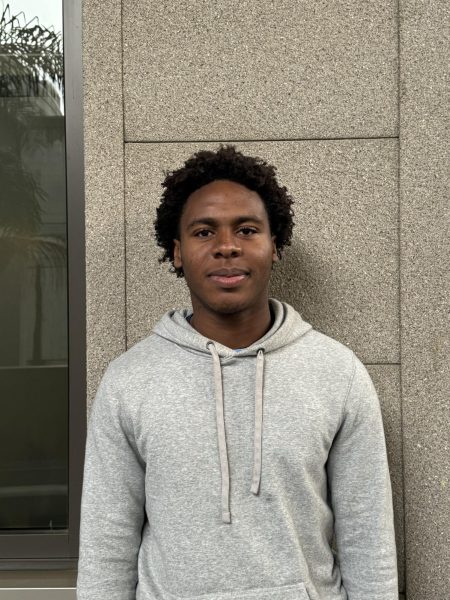
At 12 years old, Russell Weber wandered into a rundown comic shop in a Monterey mall and pulled a paperback off the shelf: “Ultimate Spider-Man.” He’d hated reading up to that point. That day rewired something.
“As a child I hated reading,” Weber said. “That changed when I was 12. I bought the first graphic novel of Brian Michael Bendis’ ‘Ultimate Spider-Man,’ and that was just the beginning of what has now been a 22 year obsession.” He calls that purchase the moment his love for reading began, not just for comics but for everything that would follow, including history.
Weber teaches History 29 and History 30 this semester, guiding students from the colonies to Reconstruction and then from 1865 to the present. The way he teaches is stitched from the same fabric as his first brush with Spider-Man. You jump into the story midstream, learn the heroes, the villains and then reach back for earlier issues that reshape what you thought you knew.
Weber says, “It would be impossible for most people when they start reading to go back to the very first issue.” Referring to comics released by what Weber called “the big two,” Marvel Comics and DC Comics. “So you kind of jump in in the middle then you read these older stories that then influence the way that you think about the stories that are newer, which is the same thing that historians do.”
Weber grew up on the Peninsula, as an only child raised in the San Bruno and Pacifica area. His father served in the Navy, then worked as a civilian engineer and his mother was an administrative assistant at a local Catholic church. He spent 13 years in taekwondo, ultimately earning a third degree black belt. “I was there for 13 years,” he said. “It was a good amount of time in my life.”
Comics eventually became the hobby he spends “the most time in.” His preferences are clear yet open handed. “When I was a teenager, I would have said Marvel. I think currently I would have to say DC,” Weber said, adding that Marvel’s teenage energy pulled him early while DC’s mythic archetypes feel sharper now. He resists gatekeeping. “I’m very opposed to comic book gatekeeping,” he said, rejecting the idea. “I think these characters are really flexible and really malleable. And I think that as long as you’re not changing core values about them. It’s fine.”
But Weber is not just a fan of the comics — he appreciates the success of the Marvel Cinematic Universe and blockbuster superhero moves. Remembering the jolt of “Iron Man” and the audacity of “Endgame,” Weber says “I think they did a lot of good for normalizing comic book culture.” Matt Reeves’ “The Batman” struck him too, down to its millennial mood. As for favorites, he goes with Andrew Garfield’s Spider-Man and Kevin Conroy’s animated Batman, with a soft spot for Adam West’s camp.
If comics trained Weber to treat stories as living things, graduate school turned that instinct into a scholarly method. After earning his bachelor’s and master’s at San Francisco State, he headed to UC Berkeley, where he focused on U.S. and Atlantic world history with a specialty in political culture and the history of emotions.
“I started focusing on rhetoric and discourse and that’s what led me to emotions,” he said. “How we use emotions to try to achieve things, whether its political goals, social goals, cultural goals and the difficulty of figuring out things like sincerity of emotion.”
One late 2016 day crystallized the project. Weber was transcribing Samuel Adams’ epistles in the Boston Gazette about the Boston Massacre while his officemate played NPR. “I have to stop because I can’t keep track of which one is which,” he said. The cadence of Adams on the page blurred with Donald Trump’s stump speeches on the radio. “Both of them are using very similar impassioned rhetoric. That was kind of the moment where I was like, oh, this might be worth looking at.” The overlap wasn’t a partisan gotcha, it was a question about how emotion works in politics then and now.
Weber’s teaching pushes that same inquiry. “You want to try to teach skills,” he said. “How to be critical thinkers, better writers, better readers. You do want to cover content.” This term in History 30, for instance, he has students examining the Chinese Exclusion Act and Supreme Court rulings that narrowed the 14th Amendment, then connecting those rulings to the present. Above all he wants students to see that history is interpretive.
“Just because I have a PhD doesn’t mean I know everything,” he said. “They have as much ability to reinterpret and try to facilitate new perspectives. All it requires is for you to be willing to spend a lot of time reading, thinking critically and getting told this is a good start, but you need to make your argument a lot clearer.”
The comic book metaphor gives students an entry point. He likens the Civil War’s ending to the end of Issue No. 3 in a long event series, not the end of the run. “A lot of historians talk about the Civil War as ending the first American Republic,” he said. From there, the arcs shift. Whether we are in a third or fourth republic is “still being hashed out by historians and scholars,” but the key is treating the nation’s narrative as something you can periodize and debate.
Weber also enjoys finding the side characters history forgot. Wikipedia, used carefully, helps. “You always have to verify,” he said, but it can surface figures like Melanchthon Smith, whom he calls Alexander Hamilton’s biggest rival in New York’s ratification fight. “Part of what we’re supposed to do as historians is help bring those people to light,” he said. He wants students to verify, then contribute, turning curiosity into public knowledge.
His view of contingency runs deep. He is “very sympathetic to British loyalists” and fascinated by the 1778 Carlisle Commission, a British peace offer he argues could have kept the colonies in the empire. In a different Congress, he said, the offer might have been accepted, reshaping the 19th century and delaying British abolition. Whether you agree or not, the point is to ask the what ifs, to see how small turns shift the dominoes.
Weber’s pop culture map makes room for real life too. He is a soft taco purist — “tortilla, meat, salsa, cilantro and onions” — with enough humility to admit he will still eat Taco Bell in a pinch. He loved Edinburgh on a first trip abroad with his wife, fell for Seattle and wants to walk Ireland after years of reading about the 18th century Atlantic world. Richmond, Virginia, grabbed him during a 2018 research stay when student activists confronted the city’s Confederate memory.
There is a more personal note as well. “Good Will Hunting” remains his favorite film because it helped him process family trauma tied to alcoholism. “It kind of resonated with me in a way where I was like, oh, other people experience this too,” he said.
If there is a unifying lesson in Weber’s classroom, it is that nothing humans build is permanent, which makes change both possible and risky. “Nothing that human beings create is immutable,” he said, pointing to how quickly the Articles of Confederation gave way to the Constitution without legal permission to do so. The takeaway is less cynicism than agency.
In Weber’s classes, students don’t just read a chapter and move on. They open an issue, chase a thread, find an older panel that reframes the whole arc. Then they argue about what the next issue should be. As Weber would put it, the story is still being written and everyone in the room gets a pencil.