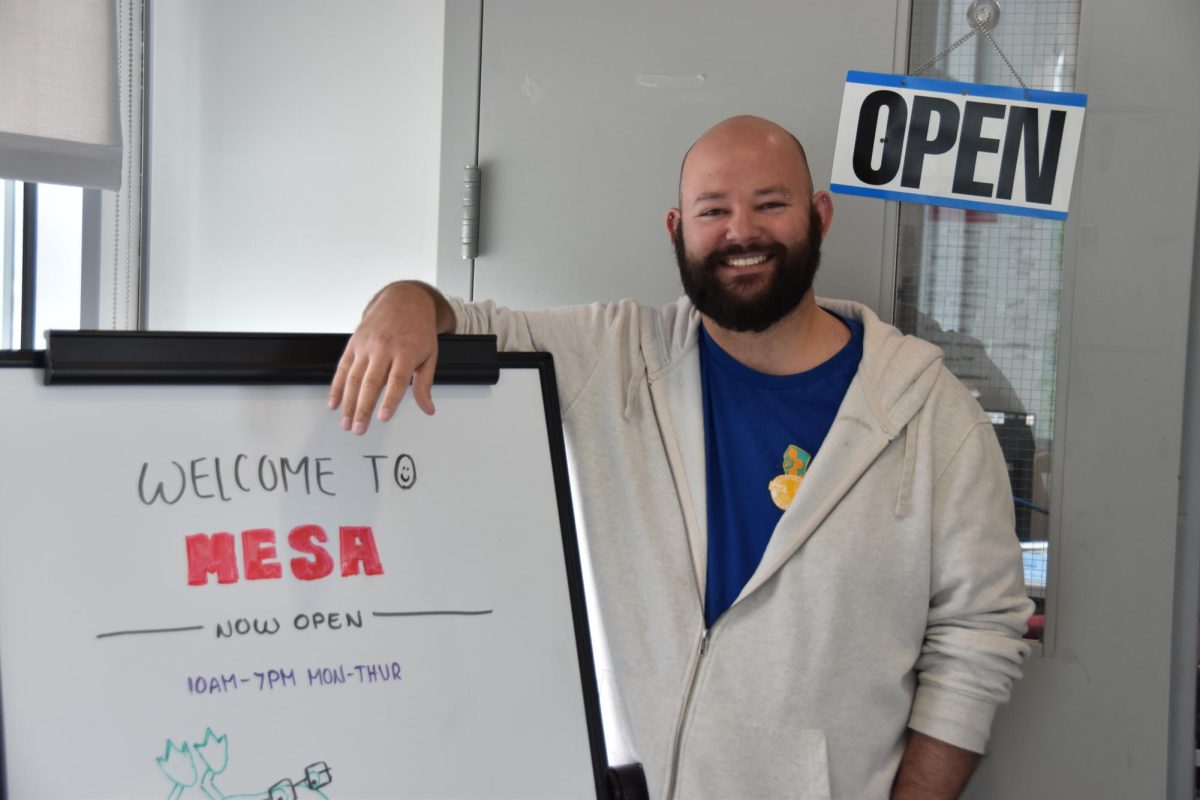
Long before he became the coordinator of the Math Engineering Science Achievement program at Los Medanos College, Michael Simpson was just another student trying to figure things out. He remembers the uncertainty of being a first-generation college student, not always knowing where to go for help or what resources were available. Now, years later, Simpson walks across the same campus making sure students never have to feel as alone as he once did. Whether he is helping a student navigate transfer requirements, hosting a movie night centered on STEM innovators or simply stopping for a conversation in the hallway, Simpson has built a reputation for meeting students where they are and reminding them that they belong.
Born and raised in Antioch, Simpson graduated from Antioch High School in 2008 before enrolling at Los Medanos College. At the time, he planned to become a high school English teacher, but his experience at LMC quickly evolved into something much larger.
“I really, up until graduating high school, wasn’t even aware that Los Medanos College was here,” Simpson said.
During his second year at LMC, Simpson joined the college’s theater program and discovered a creative passion that reshaped his academic path. He became one of the first students to earn both an associate degree in drama and an associate degree for transfer in theater arts from the college before transferring to the University of Idaho, where he earned a bachelor’s degree in theater arts.
Even while studying theater, Simpson’s educational journey was shaped by financial realities familiar to many community college students. He waited until he was 24 years old to apply for financial aid independently after realizing his family’s income looked different “on paper” than it did in reality.
“We’ve always been lower middle class,” Simpson said. “So on paper, it looked like we made too much money, but in reality, we didn’t make enough money.”
That lived experience now informs the way Simpson works with students in MESA, a program that supports first-generation and historically underserved students pursuing STEM majors. Since stepping into the MESA coordinator role in March 2025, Simpson has focused on building a program that feels approachable, community-centered and supportive beyond academics alone.
Much of that approach comes from his years working in admissions and records, where he regularly helped students navigate graduation requirements and transfer pathways. Simpson also credits his theater background with helping him think creatively about student engagement.
Instead of limiting MESA programming to workshops and tutoring, Simpson has introduced mindfulness activities, movie nights and culturally focused events that blend STEM with storytelling and identity. One example was a screening of “The Immortal Life of Henrietta Lacks” during Black History Month, highlighting the contributions of Black innovators and the importance of representation in science and medicine.
“I really enjoy building community and connecting students to resources, mentors and each other,” Simpson said.
Students often see Simpson as more than a coordinator. He is someone who understands the pressure many of them carry outside the classroom. In conversations with students, Simpson frequently reminds them that academic setbacks do not define their worth.
“One bad grade on a test does not define who you are academically or as a person,” Simpson said. “It’s very easy to get down on ourselves and feel like a failure. But one thing that you fail at does not mean that you are a failure.”
That message resonates because Simpson speaks from experience rather than theory. As a first-generation student himself, he understands the challenge of balancing school, finances and personal responsibilities while trying to build a future. He said many students wear multiple “hats” at once, acting as students, family members, workers and caregivers all at the same time.
Outside of MESA, Simpson also serves as vice president of Local 1, supporting classified professionals across campus by advocating for fair working conditions and equitable treatment. Though he describes the work as difficult, he remains committed because he believes supporting colleagues ultimately benefits students too.
At the center of Simpson’s work is emotional awareness. Whether advocating for coworkers or helping students navigate college for the first time, he approaches people with patience and understanding. It is the same kind of kindness he remembers from his favorite third-grade teacher, Mrs. Brown, who still sends him photos every year of a handmade holiday decoration his family gave her as a child.
Years after first arriving at LMC unsure of what direction his life would take, Simpson now spends his days helping students believe that they are capable of finding their own paths too.