A whirlpool of emotions swirled throughout the recital hall during Los Medanos College music professor Haksung Lee’s recital and lecture on Franz Schumert’s “Winterreise Through Ecomusicology.”
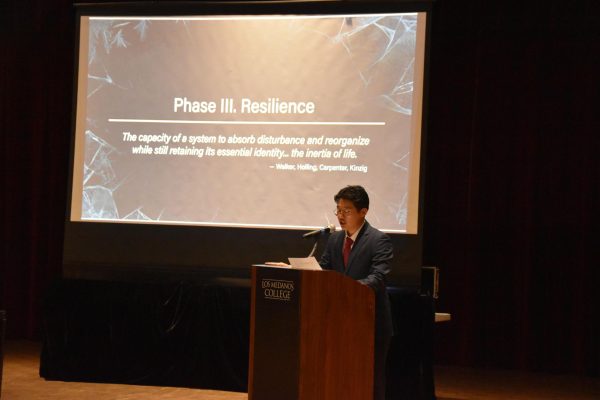
The lecture, which highlighted Schumert’s Winterreise, was split into three phases: eco-anxiety, solastalgia and resilience. It was presented through the lens of ecomusicology and climate psychology.
It examined how the work resonates with the psychological journey from a modern climate crisis. Lee’s ultimate goal in the lecture seeks to expand the discourse of Winterreise beyond its 19th-century Romantic origins, positioning it as a contemporary site for reflecting on the human psychological experience in the face of environmental crisis, according to the recital program.
Lee’s lecture then went on to explain the conceptual triad.
As stated by him, eco-anxiety refers to “existential distress regarding future uncertainty and vulnerability caused by environmental destruction.” Solastaliga refers to “the profound homesickness experienced when one’s home undergoes physical degradation—feeling homesick while still at home. Resilience refers to “The dynamic capacity to restructure identity amidst disturbance—the “inertia of a life that refuses to stop.”
He reiterated eco-anxiety by recalling how in South Korea, his home country, people separate their trash, recycle and care about the environment they live in, unlike in other places where everything goes into one bin for the landfill. “California is different actually, they put the effort into recycling,” said Lee.
Lee then explained the song “Will-o’-the-wisp,” which he interpreted as mapping the erratic false guidance to the psychological instability of the climate crisis.
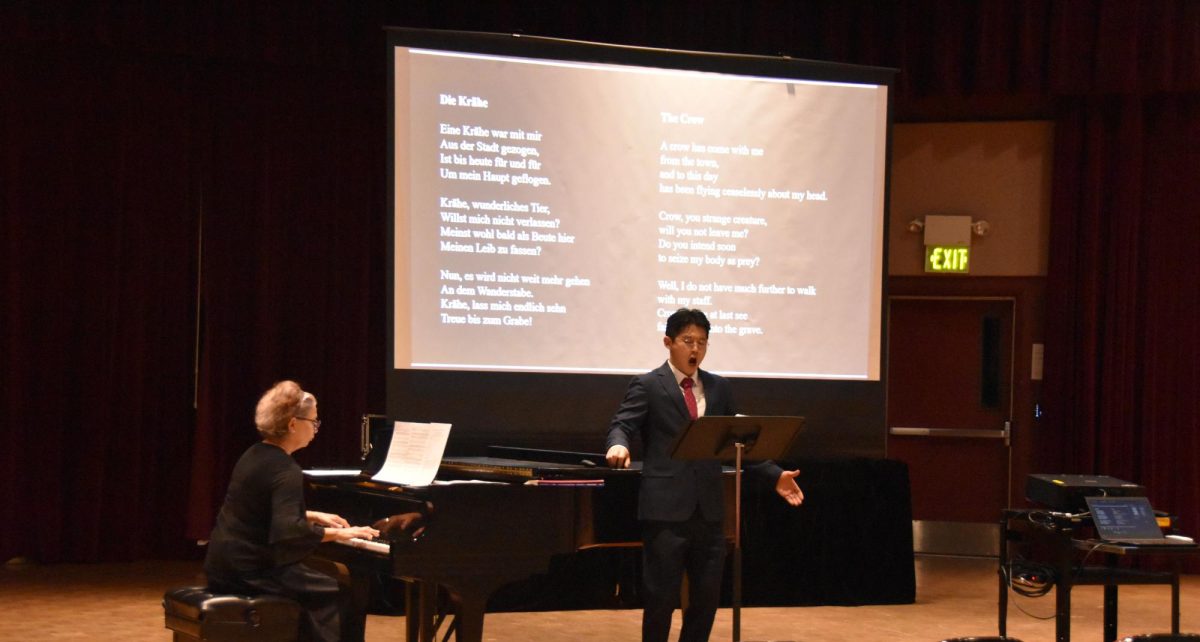
He then performed “The Crow,” delivering an exhilarating and powerful performance. It filled the room with wonder and excitement as he belted his vocals throughout the song. He interpreted it as nature being a hostile, predatory force rather than a source of solace, fitting the theme of eco-anxiety and navigating the unstable future.
After each performance from Winterreise, the room erupted with thunderous applause.
LMC student Oliver Rincon said, “I liked the story he was going with because it felt like he picked his best songs from the 24-song list. So we didn’t have to listen to 24 songs, but it was still good, and I thought it was a cool little way to look at certain songs.”
Rincon also said Lee’s recital stood out compared to others at LMC. “Usually they’re like ‘Hey this is the class, they’re gonna be playing their songs.’ This one was like, this is my equivalent of when you’re in an art class they make you do a bunch of paintings on the same thing. This, he did a bunch of research on the same thing, then here, let me explain it. And then you listen to it.”
Professor Lee said that after receiving his master’s and doctoral degrees from the University of Cincinnati College-Conservatory of Music, his first job was at LMC, where he currently teaches vocal and choir classes.
On his overall performance, Lee said that it went well. “The audience was really good, everybody concentrated on my presentation and my performance,” he said. “I enjoy being on stage.”